Introduction
In the construction sector, artificial intelligence has moved beyond the theoretical phase into one of empirical validation. The relevant distinction today no longer lies in the availability of the technology, but in the ability to integrate these systems to extend analytical and decision-making capabilities across the entire lifecycle of the built asset. To ensure a rigorous reading of the market, the case studies presented here were selected according to a methodological framework requiring the physical existence of completed works, technical verifiability of the AI employed, and the presence of measurable impact on time, quality or safety. AI acts here as a cognitive layer that transforms the complexity of the built environment into verifiable data and informed actions, and it is precisely in this function of supporting human work that its real value is measured. In selecting the cases, we have deliberately distinguished AI – understood as a model that learns, predicts, classifies and optimises – from the vehicles on which it often travels: BIM, sensors, robotics and site automation. When a robotic system performs a complex operation, the value does not reside in the mechanical arm but in the model that decides when, where and how to act. It is this cognitive layer that changes the paradigm of collaboration between people and machines, because it gives the operator back time, safety and the capacity for qualified intervention. The six cases presented are ordered according to the phases of a project, from conception through to maintenance, to show how AI acts at every stage of the asset lifecycle, always as an amplifier of human capabilities rather than a substitute.
Design Phase: Nrep and Spacemaker / Autodesk Forma (Nordic Countries)
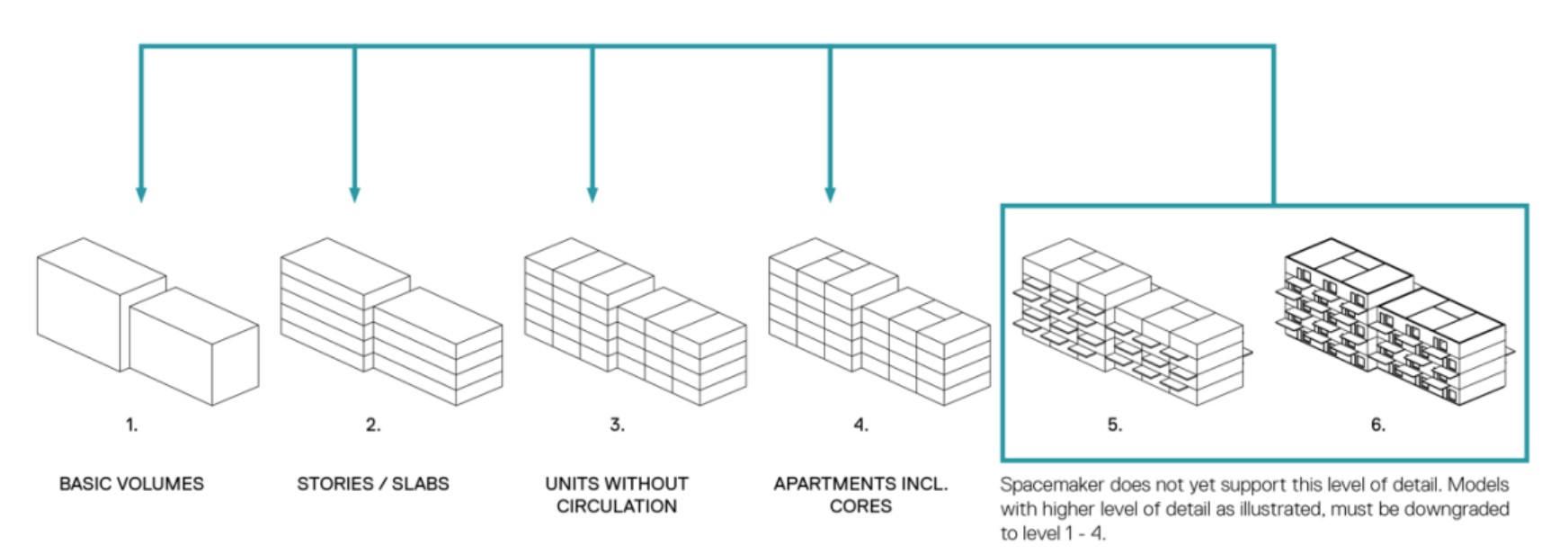
Spacemaker was founded in Oslo in 2016 and acquired by Autodesk at the end of 2020 for 240 million dollars, integrated in 2023 into the current Autodesk Forma platform. It is a cloud-based generative AI system that explores billions of volumetric configurations on a plot, evaluating each against environmental parameters such as natural light, street noise, wind, thermal comfort, views and residential density. Among the first European clients is Nrep, a Nordic real estate group, which adopted the platform on its residential projects in Sweden and Denmark. On a Nrep pilot case – an area of approximately 12,500 square metres intended for studio apartments – the system made it possible to increase the number of realisable apartments by 6% and, by reorganising a single building, to bring a courtyard from zero to more than six hours of daily sunlight. On another project, a large Nordic residential development, the AI enabled a 16% increase in density and 33% more sea-view apartments, for an estimated value exceeding eight million euros. A major European architecture firm, also cited by Autodesk, reported a 50% productivity gain in the early project phases. AI here does not design the building in place of the architect. It generates the space of possible alternatives and returns it ordered by measurable qualities, leaving the designer the synthetic, contextual and cultural judgement that remains irreducibly human. The operational gain for the professional is twofold. On one hand, the liberation of time previously spent on the manual production of variants – time that can now be invested in dialogue with the client and in the qualitative refinement of the preferred solution. On the other, the ability to bring demonstrable arguments to the client table. A volumetric choice ceases to be an opinion and becomes data. This is a form of cognitive support that rebalances the dialogue between designer and client, even for small practices operating in the cloud on a browser with no hardware investment.
Materials Phase: ViliaSprint² (Bezannes, France)
In Bezannes, France, ViliaSprint² was delivered in April 2026 – the largest multi-storey 3D-printed residential building in Europe. Three floors, 800 square metres, twelve social housing units, commissioned by operator Plurial Novilia. The paradigm-shifting data point is clear. The structural shell was completed in 24 effective printing days against the 50 initially planned, reducing structural construction time by 50% compared to a twin building constructed in parallel using traditional methods on the same plot. The workforce engaged in the printing phase fell from six to three operators, eliminating heavy manual lifting. Behind this result there is not simply a large-format 3D printer. There is an ecosystem of applied AI that is often the true invisible enabler. TectorPrint, developed by Holcim and used in the project, is the product of AI-assisted optimisation of the concrete mix, balancing three conflicting objectives: the printability of the fresh material, structural resistance on hardening, and carbon footprint. The result is a 30% reduction in CO₂ compared to conventional reinforced concrete and a 10% reduction in concrete volume through geometric optimisation of the curved walls. Hélène Lombois-Burger, Head of R&D Concrete and Aggregates at the Holcim Innovation Center, puts it clearly: 3D printing in construction is not just about robots, but an ecosystem where the material assumes structural autonomy, and where AI itself makes this autonomy possible. The support to human work manifests on two levels. On one hand, physical effort on site is drastically reduced, with the crew engaged in lifting operations halved. On the other, the work becomes more skilled. Three operators managing the process from a tablet replace six workers engaged in repetitive and physically demanding activities. In a sector that faces a severe labour shortage across Europe, this shift makes the profession more attractive to younger generations and more sustainable for those practising it today. Plurial Novilia has already planned the next phase: a forty-unit development with two printers operating in parallel.
Construction Phase, Residential Scale: Cartesius (Utrecht, Netherlands)
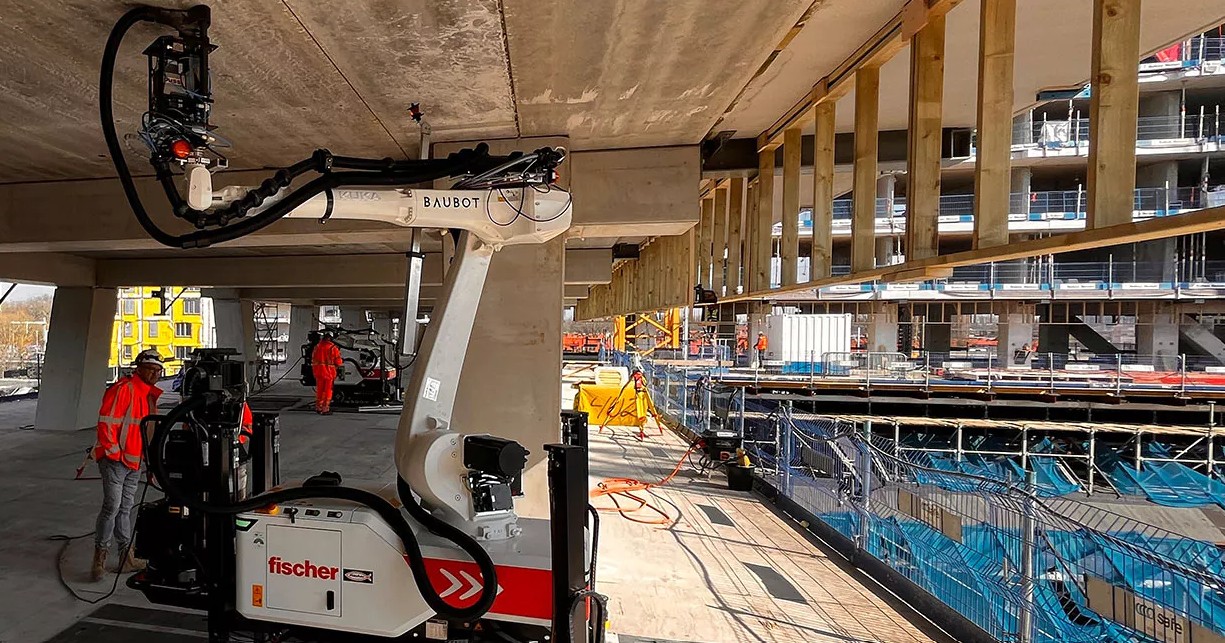
The Cartesius district in Utrecht is an urban regeneration project oriented towards health, cycling mobility and sustainability, designed for approximately 1,100 residents across five buildings. The fischer BauBot system was deployed to execute approximately 4,800 overhead holes for MEP anchors, under complex operational conditions: a reduced clear height of 2.7 metres due to transverse beams, and a slab with dense reinforcement. Once again, the enabling element is not the robotic arm but the level of artificial intelligence that translates the project into action. The software pipeline recognises each drilling position in the BIM model, verifies its reachability against the actual geometry of the site, and optimises the execution sequence. Integrated sensors detect deviations from the standard process – for example, encountering a reinforcement bar – and automatically activate a pre-set alternative strategy rather than halting the system or producing an out-of-spec hole. Every operation – with actual depth, diameter and any deviations – is automatically recorded in the BIM model. Quality documentation, which in a traditional site is often the first obligation to be sacrificed when schedules tighten, becomes a natural by-product of execution. For the site operator the gain is clear. Overhead work – one of the most stressful and injury-prone activities, as documented by Hilti's own research during the development of its Jaibot robot – is replaced by a supervisory role. Automatic quality traceability protects the contractor in its contractual relations with the client, because every hole is documented and auditable. In a market where technical liability weighs increasingly on the executing party, this kind of objective evidence has a value that goes beyond operational efficiency, and directly affects the contractual and insurance position of the builder.
Construction Phase, Complex Infrastructure: Brenner Base Tunnel
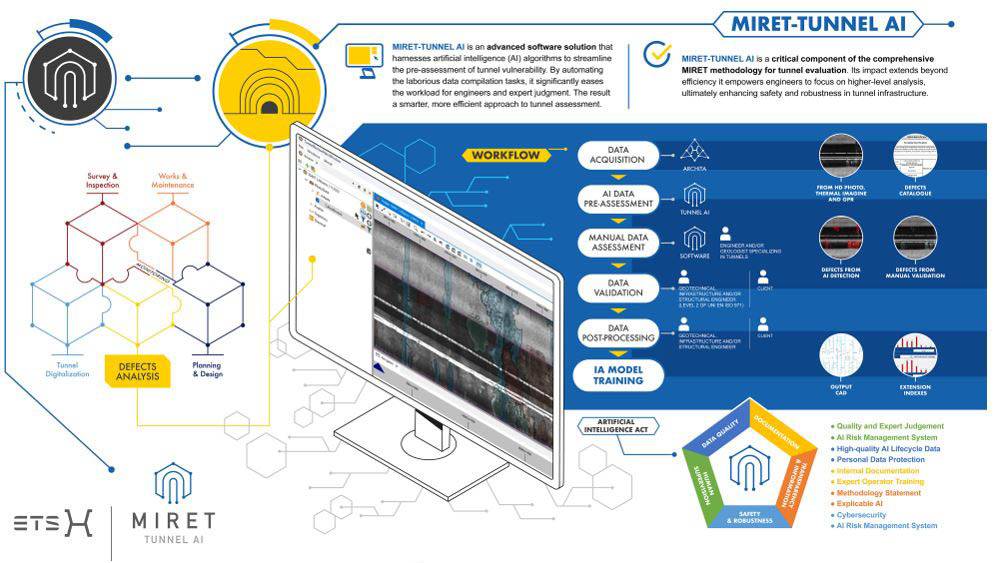
At 64 kilometres, the Brenner Base Tunnel will be the longest underground rail connection in the world, forming the central section of the Scandinavian-Mediterranean Corridor of the TEN-T network between Helsinki and La Valletta. Webuild is involved in four lots covering more than fifty kilometres in total. In September 2025, the breakthrough of the exploratory tunnel was celebrated, linking Italy and Austria underground for the first time, with the Flavia TBM completing a drive of over 14 kilometres. On a project of this scale, every metre of TBM advance carries a non-linear cost. Unpredictable geotechnical conditions can drastically reduce penetration rate and generate cascading delays across the entire works programme. Research conducted on operational data from the Mules 2-3 lot demonstrated that neural networks trained on machine parameters – specific energy, cutter head power, thrust, torque – can predict TBM penetration rate with significant accuracy, using two distinct deep learning architectures, one feedforward and one LSTM, compared on data from the exploratory tunnel and the main tunnel. The most interesting element for the debate on trustworthy AI in construction is the use of SHAP, an explainable AI method that allowed researchers to show which parameters were actually driving the model's predictions. Not a black-box AI that says 'drill slower', but a system that returns to the TBM operator the technical rationale behind the recommendation. In a regulated context such as major infrastructure, AI is only acceptable if it is auditable, and this distinction is crucial. The operational advantage that follows is the reduction of decision-making variance between different operators, on different shifts, on different sections of the same project. Even in the most extreme geotechnical conditions, AI acts as a silent co-pilot for the TBM driver, returning not just a prediction but its explanation.
Project Management Phase: HS2 London Tunnels
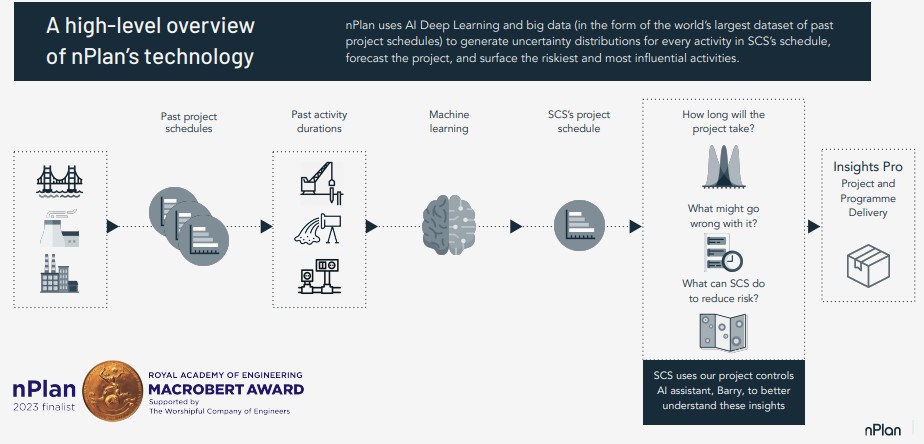
The British High Speed 2 programme represents one of the largest infrastructure construction projects in Europe currently under way. The London tunnels section is contracted to SCS Joint Venture, bringing together Skanska, Costain and STRABAG, which has integrated the nPlan platform – based on deep learning trained on tens of thousands of historical project schedules – into its project control system. Here AI does not drive a machine and does not interpret an image. It reads work plans. The model identifies, activity by activity, delay probabilities and risk patterns that traditional quantitative risk analysis methods take ten times as long to produce, reaching a level of granularity that flags, for example, expected delays in the approval of specific construction drawings. The advantage for human teams is twofold. First, the frequency of analysis shifts from monthly to continuous, because what previously required weeks of manual work is processed automatically, returning time to project controllers for strategic decision-making rather than report production. Second, and more subtly, AI compensates for the cognitive bias of planner optimism, whereby planners inevitably tend to base their estimates on the direct experience of their own team. A model that has 'seen' thousands of different projects does not share this bias, and introduces into the process a collective industry memory that no single individual could possess. For those managing the project, this means being able to engage with a system that, without prejudice, proposes an independent reading of the plan, while leaving the final word on mitigation actions to the human decision-makers.
Maintenance and Operations Phase: Ponte San Giorgio, Genova
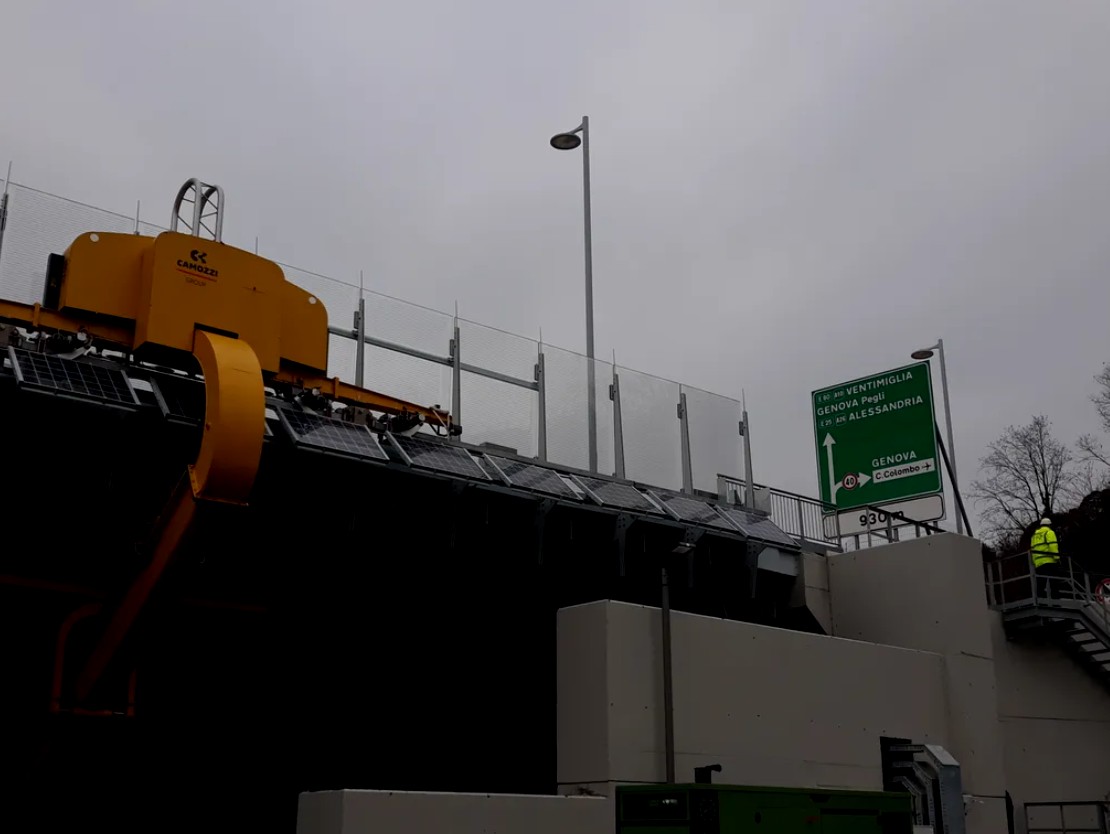
The new Polcevera viaduct, inaugurated in 2020, is equipped with an integrated structural monitoring system combining approximately 250 sensors, a dehumidification system and two families of robots – inspection robots and wash robots – designed by the Italian Institute of Technology in Genoa as part of the project built by the consortium led by Webuild together with Fincantieri. The truly enabling element is not the machine but the computer vision model that makes it useful for the maintenance of the structure. The inspection robot acquires 25,000 images every eight hours of the underside of the deck. No human inspector could process a dataset of this size on a weekly basis. The AI performs an automatic comparison between current images and the historical archive, identifying micro-cracks, oxidation or anomalies before they become macroscopically visible evidence. The so-called cognitive mechatronics of the system – its ability to autonomously recognise environmental conditions, intervention requirements and battery status – is a further on-board AI application that reduces the supervision required. As stated by Marco Bazzarello, Webuild's head of technological equipment for the bridge, the system 'has made it possible to minimise human interventions on the bridge, reducing risks to the maximum extent'. The value for the human operator is not substitution, but a shift in work. From repetitive, high-risk visual inspection carried out at height, to the analysis of alerts generated by the model and the organisation of targeted maintenance interventions. This is an exemplary case of how AI enables a shift from periodic-based maintenance to predictive-based maintenance, giving the infrastructure manager an informed intervention capability that, on an asset of this scale, would not otherwise be achievable.
Conclusion: The Challenge of Scaling
The six cases presented show an AI that is now operational across all project phases: pre-design, materials formulation, site execution, process control, risk management, and the maintenance of assets in operation. The common thread is clear. AI does not replace the human operator, it supports them. It returns time, raises the quality of work, reduces physical load in the most demanding activities, lowers the error threshold and introduces automatic documentation where traceability is critical. The most solid applications today are on major works and projects managed by structured organisations, where AI's effectiveness is proven and the economic and safety benefits are now clearly measurable. The picture changes when looking at smaller scale: the micro-enterprises and SMEs that in Europe constitute the vast majority of the construction industry. The typical execution speed of these players, combined with their capacity for adaptation to the individual project, is potentially fertile ground for well-calibrated AI applications, because compensating with technology for the reduced time available for detailed checks, structured training and document management would produce proportionally higher benefits than on major works. However, the market today does not yet offer AI solutions truly ready for the daily reality of these firms. Generative AI platforms for pre-design exist and are accessible in the cloud, but still require consolidated digital competencies. Computer vision systems for site safety are mature, but their deployment presupposes an organisational infrastructure that many SMEs do not have. Risk forecasting tools for schedules are expanding, but they have been trained on projects very different in scale and type from the small residential site or refurbishment project. The distance separating the demonstrability of AI on major projects from its real applicability in the daily practices of micro-enterprises and SMEs requires changes that are not only technological. Cultural adaptations are needed, because those working daily on site must develop familiarity with tools that today still appear foreign to their trade. Operational adaptations are needed, because the way a small firm organises its work cannot absorb processes designed for organisations of hundreds of people. And solutions designed from the outset for this market segment are needed – solutions that are accessible in cost, simple to adopt, and that deliver immediate value without requiring months of internal transformation before the first benefit is seen. This is the true frontier of AI in construction over the coming years. Not proving that it works – because this is already established on the most structured projects and contexts. Making it applicable, and above all advantageous, for the small and medium-scale projects that represent the real heart of the European construction market. It is the scaling challenge that will make the difference between an AI that remains a technology for the few and an AI that becomes an ordinary working tool for those who build every day.

References
https://nrep.com/news/nrep-pioneers-artificial-intelligence-in-real-estate-using-spacemaker/https://investors.autodesk.com/news-releases/news-release-details/autodesk-completes-acquisition-spacemaker-provider-ai-andhttps://static.au-uw2-prd.autodesk.com/Class_Handout_AS500351_ClassHandout-AS500351-Gameiro-AU2021.pdfhttps://www.holcim.com/who-we-are/our-stories/3d-printed-residential-buildhttps://www.peri3dconstruction.com/en/mehrfamilienhaus-bezanneshttps://www.baubot.com/post/using-robotics-to-drive-project-successhttps://www.fischer.it/it-it/ingegneria/baubothttps://www.webuildgroup.com/en/media/press-notes/brenner-base-tunnel-completed-first-tunnel-italy-austria/https://www.sciencedirect.com/science/article/abs/pii/S0886779823002699https://www.nplan.io/case-studies/how-ai-led-forecasting-and-risk-management-is-being-used-to-construct-the-hs2-london-tunnels-joint-case-study-by-nplan-skanska-costain-strabag-in-partnership-with-hs2https://www.enr.com/articles/55472-nplan-promises-better-risk-management-through-ai-for-11b-uk-rail-projecthttps://www.webuildgroup.com/it/media/comunicati-stampa/nuovo-ponte-genova-san-giorgio-i-robot-al-lavoro-25-000-fotografie-ogni-8-ore/https://transport.ec.europa.eu/transport-themes/infrastructure-and-investment/trans-european-transport-network-ten-t/scandinavian-mediterranean-corridor_enStay informed
One email per month. R&D and innovation news for the construction industry.
No spam. Unsubscribe at any time.