Robotic & Automation for Construction: Robotic Products for Digital Workflows

Make It Digital 

Robot&Automation 

Series: Make It Digital Rob-02 

Article 02/26 


Robotic & Automation for Construction: Robotic Products for Digital Workflows 

The systemic change toward a digitally integrated construction site could be enhanced on the physical deployment of robotic units capable of bridging the gap between digital representation of built environment via CAD and BIM, and jobsite execution. Following our analysis of the stakeholders driving this evolution, we now focus on some of the robotic products which are currently optimizing tasks automation and addressing human augmentation tasks deployment. These technologies address core industry challenges: labor shortages, safety risks in repetitive tasks, and the persistent productivity gap. 

By classifying these solutions based on their field of application, ranging from general building operations to specialized infrastructure works, we can observe how automation is replacing manual, error-prone processes with high-precision digital execution. The perspective is to transition from traditional manual labor to a proactive, data-driven construction environment.


Automated construction operations and site execution 

Building on-site operations: layout and structural masonry 

The initial phase of any on-site operation requires the precise translation of digital designs into physical coordinates. The HP SitePrint layout robot serves this specific function, autonomously printing complex floor plans directly onto the jobsite slab. By integrating directly with cloud-based BIM data, the system eliminates the traditional, manual marking process. Its impact is measured by the reduction in layout time and the high-fidelity alignment between the "as-designed" and "as-built" setting out, preventing downstream errors. 

Moving from layout to structural assembly, the FBR Hadrian X represents a significant shift in autonomous masonry. This truck-mounted system utilizes a telescopic boom to lay structural blocks according to a 3D CAD model. By using a specialized adhesive instead of traditional mortar, the Hadrian X achieves high lay rates and structural precision with minimal material waste. This application is highly effective for residential and commercial building shells where speed and consistency are primary drivers for schedule optimization. 
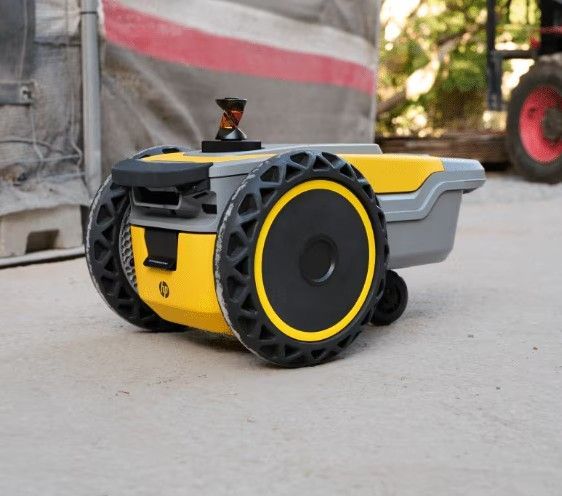

Fig.1 - HP Siteprint


Infrastructure operations: specialized heavy automation 

Large-scale infrastructure projects, such as bridges and highways, require automation capable of handling high-volume, repetitive structural tasks. The Advanced Construction Robotics TyBot is a specialized autonomous solution for rebar tying on bridge decks. The TyBot navigates the rebar mat autonomously, identifying and tying thousands of intersections without manual intervention. This allows human crews to focus on complex placement while the robot manages the critical path of reinforcement. The primary metric for TyBot is the increase in ties per hour and the reduction in musculoskeletal risks for workers. 

For large-scale earthworks, the Built Robotics Exosystem provides a scalable solution for infrastructure and energy projects. This AI-driven aftermarket kit transforms standard heavy machinery, such as excavators, into fully autonomous robots capable of performing complex trenching and digging tasks. Utilizing GPS, LiDAR, and computer vision, the system allows equipment to operate without an on-board operator, ensuring consistent excavation depth and precision. The adoption of this technology facilitates 24/7 operations, effectively removing workers from hazardous trenching environments and increasing site productivity by up to 30%. 
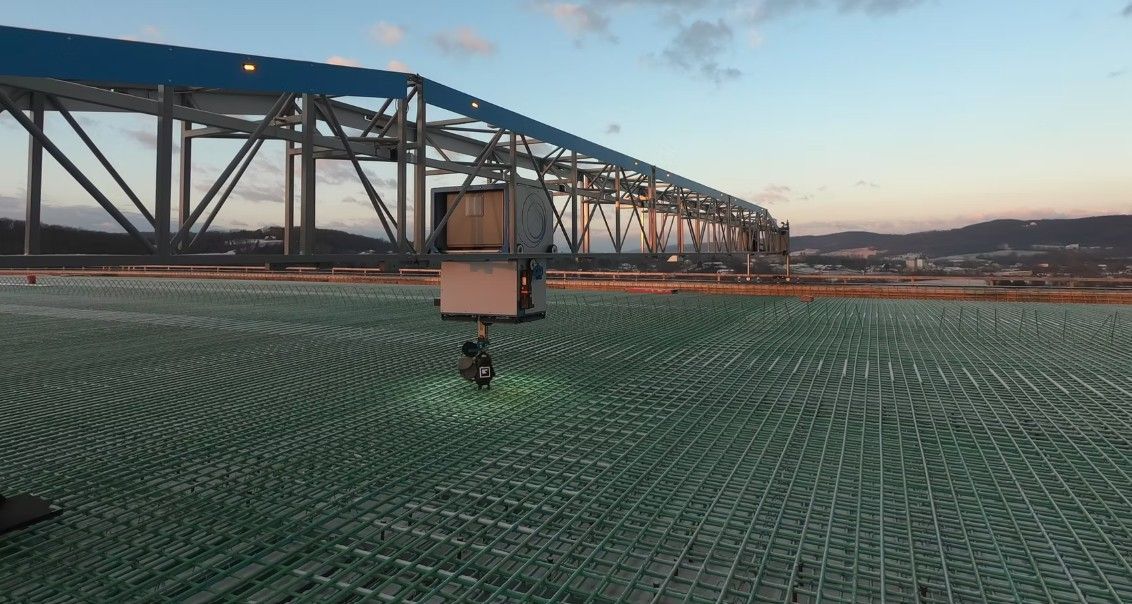

Fig. 2 - Tybot robot


Finishing and interior installation systems 

Once the structure is established, interior finishing and MEP (Mechanical, Electrical, and Plumbing) installations require precise, semi-autonomous movements. The Hilti Jaibot is a mobile drilling robot designed for overhead MEP installations. This product is the result of a strategic collaboration between Hilti and the Norwegian startup nLink, aimed at automating strenuous drilling tasks. By following BIM-defined coordinates, the Jaibot executes precise anchor holes, ensuring that all ceiling-mounted systems are installed exactly where the digital plan dictates. 

Complementing this is the Canvas (a JLG company) drywall finishing robot. This system automates the spraying and sanding of joint compound, achieving consistent finishes. The use of Canvas reduces the time required for finishing while protecting workers from the respiratory and physical strain of manual sanding. Its integration into the workflow ensures that interior quality is maintained at a high industrial standard regardless of labor availability. 

Cross-cutting site intelligence and monitoring 

A fundamental component across both building and infrastructure fields is the ability to monitor progress autonomously. The Boston Dynamics Spot robot, often utilized by contractors like Skanska for site monitoring and novel applications such as debris management, serves as a mobile sensing platform. When integrated with FARO/HoloBuilder technology, Spot performs autonomous site walks to capture 360-degree imagery and laser scans. This data is fed into digital twin platforms, providing stakeholders with real-time visibility into project status and replacing sporadic, manual site inspections with continuous, objective documentation. 
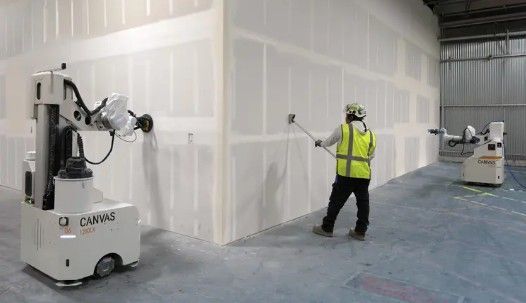

Fig. 3 - Canvas robot


Conclusions 

The robotic products currently available for the construction sector demonstrate a clear move toward specialized, task-oriented automation. From the HP SitePrint's layout accuracy to the heavy-duty infrastructure capabilities of TyBot and the interior precision of the Hilti Jaibot and Canvas, these machines are redefining the jobsite. By delegating repetitive, dangerous, and high-precision tasks to robotic units, the construction industry achieves higher productivity and safer working conditions. At Levery, we recognize that the future of construction is centered on the seamless integration of digital intelligence and robotic execution. 


References 

HP SitePrint. Layout Robot Technology 

JLG Canvas. Drywall Finishing Robot 

Advanced Construction Robotics. TyBot Rebar Tying Robot 

Built Robotics. Exosystem for Autonomous Earthmoving 

FBR Limited. Hadrian X Autonomous Masonry 

Hilti Group. Jaibot Semi-Autonomous Drilling 

nLink Robotics. Our Story and Hilti Collaboration 

Skanska USA. Spot the Robot on the Jobsite 

Boston Dynamics. Spot for Construction Monitoring 

Levery S.r.l. Società Benefit. Robotic & Automation for Construction: Actors and Stakeholders 


CALL FOR ACTION

Start your automation journey today with Levery and transform your construction projects or your building products into energy-generating, future-ready buildings. Let’s work together to create buildings that benefit people, enviroment and economic.


Contact us now to discuss how we can help you integrate robotic solutions into your next project and drive the shift toward a greener future.


Contact Us
By AP January 7, 2026
Make It Green Bio-based Series: Make It Green BIO-02 Article 01/26 Bio-based building materials & products for construction: building components and elements The transition toward a sustainable built environment relies on the physical integration of low-impact materials into building structures. Following our analysis of the stakeholders driving this sector, we now focus on the products currently under development that are redefining the performance of both the building envelope and internal systems. These materials are moving beyond traditional timber to include high-performance composites derived from agricultural waste, fungi, and bio-polymers, aiming to replace carbon-intensive plastics, mineral wool, and concrete with alternatives that act as active carbon sinks.  The evolution of the bio-based building envelope The building envelope serves as the primary interface for energy efficiency, and current innovation is focused on optimizing thermal regulation through biological feedstock. In the sector of openings and frames, Indresmat has developed a thermal-break window frame solution using a proprietary bio-based polyurethane. By using natural oil based raw materials up to 65-75% biosourced materials, they produce frames that offer windows with thermal transmittance values (0,88 W/m2K) exceeding current regulatory requirements while reducing C-Footprint that replace 100% fossil based polyurethane applications for insulation. Thermal insulation is also being transformed by the use of mycelium and wood waste. Mykor produces highly insulating panels by growing fungal root structures on industrial wood residues. This process creates a carbon-negative product that sequesters more carbon during its growth phase than is emitted during its processing. These panels achieve thermal conductivity levels comparable to mineral wool but offer superior acoustic performance and fire resistance without the use of toxic chemicals. Complementing these solutions are advanced bio-foams and bioceramics, such as those developed by 4D-Mater . Their "Grow-Foams" leverage porous biological structures to provide a high strength-to-weight ratio, offering a lightweight alternative for infill panels and partitions. Similarly, for structural and infill masonry, the Mattone di Canapa by Biomat (Pedone Working) represents a mature solution. This hemp brick, composed of hemp shives and natural lime binders. It provides high thermal inertia and regulates indoor humidity, ensuring superior hygrometric comfort for occupants a circular business model using hemp cultivation waste.
By MG November 26, 2025
Make It Digital AI Series: Make It Digital AI-01 Article 12/25 AI as a Copilot for Construction: Revolutionizing the Building Sector Value Chain Introduction: The Disruptive Role of AI The global construction industry is on the verge of an epochal transformation, driven by the imperative to increase safety, productivity, and sustainability. This evolution is embodied by Artificial Intelligence (AI), which is rapidly shifting the sector from manual and reactive processes to predictive and optimized workflows. AI is no longer a futuristic concept but a digital copilot that integrates along the entire project lifecycle: from generative design to site management, through to maintenance and energy performance monitoring (end-of-life). Its impact is disruptive: AI can process vast amounts of data (BIM, GIS, images) in seconds that would take weeks manually, significantly improving design accuracy, drastically reducing on-site errors, and the enormous associated material waste. This transition requires a sophisticated Networking Ecosystem, where technology developers, data providers, and end-users (construction companies and design firms) collaborate to validate and scale AI solutions. Key Actors and Stakeholders in the AI Construction Ecosystem The success of AI adoption in construction relies on distinct stakeholders, each pioneering solutions that map directly onto critical phases of the building lifecycle from initial conception to long-term performance. A. Design and Pre-Construction Pioneers These actors focus on the digital planning phase, leveraging AI to automate repetitive tasks, ensure compliance, and streamline data flow before the first shovel hits the ground. Their key contribution is risk mitigation and design efficiency. Design software developers (BIM/CAD integrators): embed AI directly into core design tools, transforming static models into intelligent data platforms that can self-check and recommend optimizations. Digital compliance providers: automate the comparison of design models against complex local and international building codes, eliminating manual checklist processes. Clev: The Intelligent BIM Copilot Clev stands as a BIM/CAD AI copilot dedicated to accelerating project iterations and centralizing complex data management. Its AI capabilities drastically reduce review times (up to 80%) by eliminating the need for hundreds of disjointed plugins. Crucially, Clev automatically performs 100% compliance verification against norms, ISO standards, and client-specific rules. The platform also automates workflows such as Quantity Takeoff (QTO) and leverages an intelligent archive of past projects, moving valuable design knowledge from silos to an actionable, central resource. 
By AP October 29, 2025
Make It Digital Robot&Automation Series: Make It Digital Rob-01 Article 11/25 Robotic & Automation for Construction: Actors & Stakeholders The global construction industry is actively embracing its next major evolution, driven by the critical need for increased safety, productivity and predictability. This transformation is embodied by the rise of Robotics and Automation (R&A). Moving beyond single-task tools, R&A is integrating into the entire construction lifecycle, from design to execution and monitoring. The success of this shift relies on a sophisticated Networking Ecosystem where technology creators, research entities, large industry players and end-users collaborate to prove the value and scalability of automated solutions. The stakeholders driving this evolution are defined by their unique contribution to bridging the gap between digital planning and physical building. Actors and Stakeholders working along the automation and robotic value chain: best practices The most effective progress in construction robotics is being made by distinct actors specializing in different parts of the digital value chain. Equipment machinery manufacturers: the product innovator This category comprises the companies responsible for productizing specific, high-value robotic applications. A prime example is Hilti Group, a global leader in construction tools and equipment. Hilti’s role extends beyond mere sales; they strategically partner with specialists to industrialize robotic solutions. For instance, the Hilti Jaibot , a semi-autonomous drilling robot, is a result of their long-standing strategic collaboration, which has included work with the Norwegian startup nLink since 2021. This partnership leverages Hilti’s market access and safety standards with nLink’s robotics expertise, successfully automating the strenuous and dangerous task of overhead drilling for MEP installations directly from a digital plan. This synergy demonstrates how incumbents can integrate with agile startups to rapidly scale innovation and immediately improve on-site safety and efficiency.
By AP October 1, 2025
Make It Green Bio-based Series: Make It Green BIO-01 Article 08/25 Bio-based building materials and products for construction sector: actors and stakeholders The global construction industry is a major contributor to CO₂ emissions and resource consumption. But what if our buildings could actively help us reducing sources consumptions using products from secondary raw materials? That's the promise of bio-based materials, which are derived from renewable biological resources like plants, animals, and microorganisms. These materials can sequester carbon, reduce reliance on fossil fuels, and offer thermal, acoustic, and health benefits for building occupants at least similar to the traditional products. However, the transition from conventional to bio-based materials isn't just about the products themselves. It's about a fundamental shift in the entire value chain, driven by a diverse group of stakeholders. From farmers growing the raw materials to policymakers setting new standards, a collaborative ecosystem is essential for success. This requires setting clear targets and measuring impacts to ensure a sustainable and scalable transition. Actos and Stakeholders working along the bio-based value chain: best practices. Navigating the landscape of bio-based construction requires understanding the key players and their roles. Here are six best practices that highlight how different actors and stakeholders along the supply chain are collaborating to scale up the use of bio-based materials. Raw material suppliers (feedstock processor) A new and critical player in the bio-based ecosystem is the agrowaste player or feedstock processor. These are companies and organizations that specialize in collecting and transforming agricultural by-products, like rice husks, corn cobs, or grape pomace, into usable materials for construction. Crucially, their adoption is boosted by regional innovation anchors like local clusters. A prime example is the Agrifood Clust-ER in the Emilia-Romagna region, Italy. This private association of companies, research centers, and training bodies works to increase the competitiveness of the agri-food sector by connecting its members and focusing on the circular economy and valorization of biomass residues. The impact of this actions can be measured by the tonnage of agricultural waste diverted from disposal (e.g. grape pomace, olive pits) and the volume of new bio-based materials created. The cluster’s direct involvement is measured by the number of joint R&D projects it facilitates that successfully lead to the industrial valorization of agrowaste. At this aim, local clusters create a vital "short supply chain" network that links raw material availability (agrowaste) directly to processing innovation. The Agrifood Clust-ER specifically targets strengthening the resilience of the local bio-economy by identifying new circular production routes (like transforming olive pits into innovative composite materials), effectively turning a regional waste problem into a valuable local resource for the construction sector. With Agrifood Clust-ER and under the coordination of CETMA, Levery is starting a new project of agro-waste chain monitoring.
By MG June 26, 2025
Make It Digital XR - ARyze platform Series: Make It Digital XR-03 Article 07/25 Introduction Extended Reality (XR), encompassing Virtual Reality (VR), Augmented Reality (AR), and Mixed Reality (MR), is fundamentally transforming how we interact with our world. By seamlessly blending physical and digital realms, XR enables innovative interactions with real environments and virtual objects. While already impactful in B2C (tourism, direct sales) and B2B (manufacturing, healthcare) sectors, XR's revolutionary potential in construction is immense. It offers powerful new tools for professionals, enhancing decision-making across a building's entire lifecycle – from initial design visualization and complex on-site management to streamlined maintenance and even deconstruction. The Growing Complexity of Building Operations & Maintenance (O&M) Modern buildings are becoming increasingly complex, integrating advanced technologies that pose new challenges for preserving long-term operational efficiency. Building envelopes now incorporate sophisticated active components like intelligent solar shading, automated openings, environmental sensors, photovoltaic modules, and advanced plant systems. While these innovations promise improved environmental performance and comfort, they also demand updated management and maintenance models. Traditional, largely reactive and corrective maintenance approaches are no longer sufficient. Aligned with directives like the Energy Performance of Building Directive (EPBD, EU/2024/1275) and the Smart Readiness Indicator (SRI) framework, there's a growing urgency to develop innovative solutions. These solutions must preserve system functionality while simultaneously extending the building's useful life. The diverse technological nature of integrated systems and their interdependencies require technicians to engage in advanced document management (e.g., maintenance manuals, technical datasheets), analyze heterogeneous datasets, and frequently collaborate with various professionals. XR as a Game Changer for O&M: Immediate Functionalities This is where XR solutions emerge as a crucial technological enabler. They can significantly accelerate and enhance the precision of investigation and fault resolution in buildings, paving the way for fully digitized processes. In the near future, this will even facilitate the implementation of intelligent systems leveraging Artificial Intelligence (AI) for automatic fault recognition, guided maintenance support, and proactive prediction of potential malfunctions. However, the immediate opportunities offered by current XR platforms address more practical needs with instantly applicable functionalities. Let's delve into some of these key capabilities: Immersive and Contextualized Visualization of Technical Documents : XR platforms allow for the real-time overlay of digital data – such as maintenance manuals, performance metrics, maintenance histories, and 2D/3D models – directly onto the physical environment of the building. This provides contextualized information crucial for diagnostics and maintenance planning. Imagine a technician seeing the relevant wiring diagrams superimposed directly onto the electrical panel they're inspecting!
By MG June 5, 2025
Make It Digital DPP– Stakeholder Engagement and Actors' Role Series: Make It Digital DPP-03 Article: 06/25 
By AP May 6, 2025
Make It Green – BIPV V-03 BIPV in Action: Real-World Applications Driving the Sustainable Transformation of Buildings Article: 05/25 Introduction: From Vision to Implementation The integration of photovoltaic technology into the fabric of our buildings, known as Building Integrated Photovoltaics (BIPV), represents a paradigm shift in the construction industry and is one of the most promising ways to decarbonize the built environment. As cities and building practices evolve under the pressure of climate goals and energy regulations, BIPV solutions are becoming increasingly viable - not only technologically, but also economically and aesthetically. Solar panels are no longer simply add-ons to existing structures, but rather integral components that seamlessly blend functionality with sustainability. BIPV has the potential to revolutionize the way we design, build and power our environment. In this context, the role of ecodesign becomes essential: designing BIPV systems from the outset with performance, longevity, circularity and architectural integration in mind. The European project MC2.0 (Mass Customization for BIPV) investigates how stakeholders - architects, manufacturers and engineers - approach BIPV in different building typologies. By mapping practices, analyzing stakeholder needs, and testing design tools, MC2.0 aims to accelerate the development of scalable, user-centric BIPV solutions. Moving from concept to practice requires a coordinated effort between architects, manufacturers, engineers, and developers. In this third article in our BIPV series, we look at real building projects that have effectively implemented BIPV systems. More than inspirational, these case studies are critical to understanding the conditions under which BIPV thrives and the barriers it must overcome. From urban towers to student housing to iconic landmarks, BIPV is becoming a defining element of sustainable architecture. Art Meets Energy: Pavillon Novartis in Basel, Switzerland In a striking example of aesthetic integration, the Novartis Pavilion in Basel, Switzerland, scheduled for completion in spring 2022, showcases the harmonious blend of art and BIPV energy generation. Designed by AMDL CIRCLE in collaboration with architect Michele de Lucchi and located in the Novartis Park, this public pavilion features a translucent media façade with 10,000 diamond-shaped organic photovoltaic (OPV) panels with 30,000 embedded LEDs. In addition, the façade uses transparent silicon solar panels. This innovative approach not only generates approximately 15,000 kilowatt-hours of electricity annually, the equivalent of about four average homes, but also creates a visually stunning architectural statement. The diamond-shaped OPV panels and embedded LEDs create a unique geometric pattern on the facade, giving the building a distinctly modern and artistic appearance. The use of transparent silicon solar panels in the curtain wall is particularly noteworthy, as it allows sunlight to be converted into electricity without blocking natural daylight from entering the building. This dual functionality highlights the potential of BIPV to meet both energy and aesthetic requirements in architectural design. The project is widely regarded as a successful fusion of artistic vision and technological innovation in the field of BIPV, demonstrating that energy-producing buildings can also be works of art that enhance the urban landscape. The Novartis Pavilion is a compelling example of how BIPV can be seamlessly integrated into architectural design, contributing to both sustainability and visual appeal.
By AP April 3, 2025
Make it Human Extended Reality (XR) in Construction: Transforming Design, Building, and Operation Series: Make It Human - XR-02 Article: 04/25 Introduction The construction industry, long characterized by traditional methods, is undergoing a significant transformation driven by technological advancements. Extended Reality (XR) technologies are poised to redefine every stage of the construction lifecycle. XR, an umbrella term encompassing Virtual Reality (VR), Augmented Reality (AR), and Mixed Reality (MR), blends the physical and digital worlds to create immersive and interactive experiences. From initial design conceptualization to the intricacies of on-site construction, the complexities of end-of-life processes, and the ongoing demands of operation and maintenance, XR is emerging as a powerful tool for enhancing accuracy, fostering collaboration, bolstering safety, and improving overall efficiency. The increasing adoption of these immersive technologies across the Architecture, Engineering, and Construction (AEC) industry signals a fundamental shift towards a more digital and intuitive future. Companies at the forefront of XR technologies are revolutionizing workflows, reducing errors, and enhancing decision-making across the entire building lifecycle. Case Studies Transforming the Construction Sector: Virtual Prototyping and Immersive Collaboration The initial phases of any construction project, particularly design, are critical for setting the stage for success. XR technologies offer a paradigm shift in how designs are visualized and experienced. By enabling stakeholders to step into a full-scale, immersive 3D environment of the proposed building or infrastructure, XR overcomes the limitations of traditional 2D blueprints and static renderings that can often be challenging for non-technical audiences to interpret. This capability fosters a deeper understanding of spatial relationships, scale, and aesthetics, leading to more informed decision-making and reduced misunderstandings. The transformative power of XR extends beyond the design phase into the dynamic environment of the construction site itself. Augmented Reality, in particular, plays a crucial role in providing on-site workers with real-time guidance, enabling them to visualize digital information overlaid onto the physical construction environment. This capability enhances accuracy in installations, facilitates progress monitoring, and improves communication between on-site teams and remote experts. The adoption of XR in operation and maintenance offers numerous benefits. It improves efficiency and accuracy in maintenance tasks by providing real-time data and step-by-step instructions. Enhanced training for complex procedures can be delivered in a safe and virtual environment, leading to a more competent workforce.2 Remote assistance and collaboration capabilities allow for faster troubleshooting and resolution of complex repairs, reducing downtime.3 Predictive maintenance can be facilitated through the visualization and analysis of real-time data.1 Ultimately, these advantages contribute to reduced downtime, lower operational costs, and extended lifespans for buildings and infrastructure. Unity – Custom XR Development for AEC Applications Unity is a powerful real-time 3D development platform that enables architects, engineers, and construction professionals to create immersive XR applications tailored to their specific needs. With Unity, stakeholders can build VR walkthroughs, AR overlays, and MR simulations to visualize projects at full scale before construction begins. Its capabilities extend to lighting analysis, spatial awareness, and integration with BIM models, improving decision-making and reducing errors. By allowing teams to interact with a digital twin of their project, Unity enhances collaboration and accelerates design approvals, ultimately reducing costly modifications during later stages. HoloBuilder – Real-Time Remote Construction Monitoring HoloBuilder revolutionizes site monitoring by offering a 360-degree photo documentation platform powered by AI and AR. Site managers and stakeholders can track progress remotely, compare real-time conditions with design models, and streamline issue detection. The platform seamlessly integrates with Autodesk and Procore, enabling automatic updates and historical tracking. Construction teams benefit from enhanced transparency, reduced rework, and improved quality control. By bridging the gap between virtual and physical job sites, HoloBuilder ensures efficient project execution and helps maintain project timelines and budgets. 
By MG March 3, 2025
Make It Digital DPP– DPP case studies: Make It Digital DPP-02 Article: 03/25
By AP February 4, 2025
Make It Green BIPV Products: Advancing Integration in Architecture Series: Make It Green BIPV-02 Article: 02/25 Introduction Building-Integrated Photovoltaics (BIPV) represents a significant evolution in sustainable construction, transforming conventional building systems into dual-purpose components that maintain their primary architectural functions while generating clean energy. This technological advancement marks a departure from traditional design and construction approaches, where building systems played primarly passive role. By integrating photovoltaic capabilities into standard building components such as windows, facades, and roofing materials, BIPV solutions are revolutionizing the way we conceptualize building envelope systems. The integration of photovoltaic technology into building elements presents unique challenges, particularly in meeting both construction and electrical performance requirements. These solutions must simultaneously meet building elements code requirements such as mechanical strength, weather resistance, and thermal performance while meeting stringent photovoltaic standards for power generation and safety. This dual compliance requirement has driven significant innovation in materials science and engineering, resulting in sophisticated solutions that improve both building performance and energy generation capabilities.